


Mercor, the AI recruiting startup founded by three 21-year-old Thiel Fellows, has raised $100 million in a Series B round, the company confirmed to TechCrunch.
Menlo Park-based Felicis led the round, valuing Mercor at $2 billion — eight times its previous valuation, The Wall Street Journal previously reported. Existing investors Benchmark and General Catalyst, as well as DST Global and Menlo Ventures participated. General Catalyst led the company’s $3.6 million seed round in 2023, while Benchmark backed its $32 million Series A in 2024 at a $250 million valuation.
The round makes CEO Brendan Foody, CTO Adarsh Hiremath, and COO Surya Midha, some of the youngest founders of a billion-dollar startup. The two-year-old platform, which counts Peter Thiel, Jack Dorsey, and Adam D’Angelo as backers, says the latest funding will help accelerate its ability to match billions of people with their calling, applying human talent to its highest potential.
Founded in 2023, Mercor uses AI to streamline hiring. Its platform automates resume screening and candidate matching, and offers AI-powered interviews and payroll management. Employers upload job descriptions and Mercor’s system recommends the best candidates.
Mercor claims its automated system not only streamlines hiring but also removes bias from the process. That claim alleges that AI systems are less biased than humans, which hasn’t always proved to be true. Nevertheless, tech companies such as OpenAI are already using Mercor’s automated tools, which the company claims can find better human candidates than, well, other humans.
Job seekers complete a 20-minute AI interview that evaluates their skills and creates a profile. The platform then matches them with relevant full-time, part-time, or hourly roles. We collect performance data on candidates and use it to refine our predictions on who will perform best in the future, Foody said.
More on Mercor’s fundraising and AI recruitment platform on TechCrunch
Figure Introduces Helix, A Generalist Vision-Language-Action (VLA) Model
Figure is introducing Helix, a generalist Vision-Language-Action (VLA) model that unifies perception, language understanding, and learned control to overcome multiple longstanding challenges in robotics.
A detailed report on Helix can be found here: https://www.figure.ai/news/helix
Moving On IT | Authorized Partner For IT, AI, And Cybersecurity Solutions
I’ve partnered with Moving On IT, your authorized partner for navigating the complex landscape of today’s technology. Moving On IT specializes in providing cutting-edge hardware, software, and cybersecurity solutions tailored to your needs.
From robust IT infrastructure to advanced Al applications, Moving On IT empowers businesses to thrive in the digital age. Contact Moving on IT with all your IT, AI and Cybersecurity requirements. Call +1 (727) 490-9418, or email: info@movingonit.com
Microsoft Prepares For OpenAI’s GPT-5

GPT-4.5 could arrive as soon as next week, as Microsoft gets ready to host OpenAI’s latest artificial intelligence models.
Microsoft engineers are currently readying server capacity for OpenAI’s upcoming GPT-4.5 and GPT-5 models, according to a source familiar with the company’s plans. While OpenAI CEO Sam Altman acknowledged recently that GPT-4.5 will launch within a matter of weeks, I understand that Microsoft is expecting to host the new AI model as early as next week.
Codenamed Orion, GPT-4.5 is OpenAI’s next frontier model and the company’s last non-chain-of-thought model. OpenAI has already teased that GPT-4.5 could be a lot more powerful than GPT-4, but the company is also looking ahead to its GPT-5 model that will include more significant changes.
I’m told that Microsoft is expecting GPT-5 in late May, which aligns with Altman’s promise of the next-gen model arriving within a matter of months. As always, this date could shift if release plans change. We reported in October that OpenAI was originally planning to release GPT-4.5 by the end of 2024, but this was subsequently delayed to early 2025.
GPT-5 will likely be the more significant release out of the pair, and Altman has referred to it as a “system that integrates a lot of our technology.” It also includes OpenAI’s new o3 reasoning model, which the company teased during its 12 days of Christmas announcements in December.
While OpenAI released o3-mini last month, OpenAI is no longer planning to ship o3 as a standalone model, and it will instead be integrated into this GPT-5 system. This aligns with OpenAI’s goal to combine its large language models to eventually create a more capable model that could be labeled as artificial general intelligence, or AGI.
More on OpenAI’s much-anticipated GPT-5 release on TheVerge
AI Leaders Reveal The Next Wave of AI Breakthroughs At FII Miami 2025 Event
In this episode, Peter Diamandis is joined by a panel of leaders in the session Transforming Business with AI: Opportunity or Overload? at the Miami FII Conference to discuss how AI will impact every industry. Panelists include: Prem Akkaraju, CEO, Stability AI Ramin Hasani, Co-Founder & CEO, Liquid AI Jack Hidary, CEO, SandboxAQ Jim Keller, CEO, Tenstorrent Alexander Sukharevsky, Senior Partner & Managing Partner, QuantumBlack, AI, McKinsey & Company.
Wayne Rasanen’s Award Winning DecaTxt 3 | A One-Handed Keyboard
Use Discount Code NEURAL for a $15 Savings on DecaTxt 3, with FREE Shipping!
The DecaTxt 3 uses a unique "chord" system, similar to a piano. By pressing different combinations of the two keys at each fingertip, you can generate any letter or symbol.
Plus, with a single key press or a combination with the thumb keys, you can access the entire alphabet. This makes learning, using, and mastering the DecaTxt 3 a breeze.

Click here to read more about Wayne Rasanen’s DecaTxt 3, one-handed BLE keyboard
The DecaTxt 3 is a perfect solution for people with hand tremors, poor motor skills, conditions like MS, limb loss, or even vision impairment. It connects via Bluetooth and can be strapped to either hand, making it comfortable and versatile for everyone.
The new 55th Annual R&D Award Winner, DecaTxt 3 will be featured in an upcoming issue of the Florida Alliance for Assistive Services & Technology (FAAST) Newsletter.
Contact Wayne Rasanen, Founder of IN10DID, for more information on the DecaTxt 3
OpenAI CFO Talks Possibility Of Going Public, Says Musk Bid Isn't A Distraction
OpenAI’s astounding growth rate potential is luring possible investors as questions loom over whether the startup will go public.
“In terms of a multiple to pay for stock like ours, there’s incredible interest at the moment,” finance chief Sarah Friar told CNBC’s David Faber on Thursday. Its future growth potential has also enabled OpenAI to “achieve valuations that are on par with the growth rate of the scale” it is reaching.
Friar also called the possibility of the company achieving $11 billion in revenue within the “realm of possibility,” adding that the ChatGPT maker’s pace of innovation has prevented it from becoming a “commodity.”
Despite its rise to prominence, the startup is losing cash. CNBC confirmed in September that OpenAI projected $5 billion in losses on $3.7 billion in revenue for 2024. “We have managed to punch well above our weight to become effectively a hyperscaler, both in terms of the compute that we’re buying and the way we’re investing in it,” she said.
A hyperscaler refers to the major cloud computing companies with massive data centers that can rapidly size up to meet shifting storage and demands. Some of the key players with major cloud units include Amazon, Microsoft, Alphabet and Meta.
The interview with Friar comes during a pivotal time, with the startup reportedly in talks to close a $40 billion investment from SoftBank that would value it at almost $300 billion. The company was also announced last month as part of President Donald Trump’s Stargate AI infrastructure project.
More on OpenAI going public on CNBC
Stanford’s Surya Ganguli | Can AI Match The Human Brain? | TEDAI San Francisco
AI is evolving into a mysterious new form of intelligence — powerful yet flawed, capable of remarkable feats but still far from human-like reasoning and efficiency.
To truly understand it and unlock its potential, we need a new science of intelligence that combines neuroscience, AI and physics, says neuroscientist and Stanford professor Surya Ganguli.
He shares a vision for a future where this interdisciplinary approach helps us create AI that mimics human cognition, while at the same time offering new ways to understand and augment our own brains. Recorded at TEDAI San Francisco.
Neural News Network Editor, Bruce Burke Has Opening For New Clients
I currently looking for an additional company to help amplify their brand message.
For more information message me directly - I look forward to promoting your brand.
Microsoft’s New Artificial Intelligence Agent Can Control Software And Robots
Magma could enable AI agents to take multistep actions in the real and digital worlds.
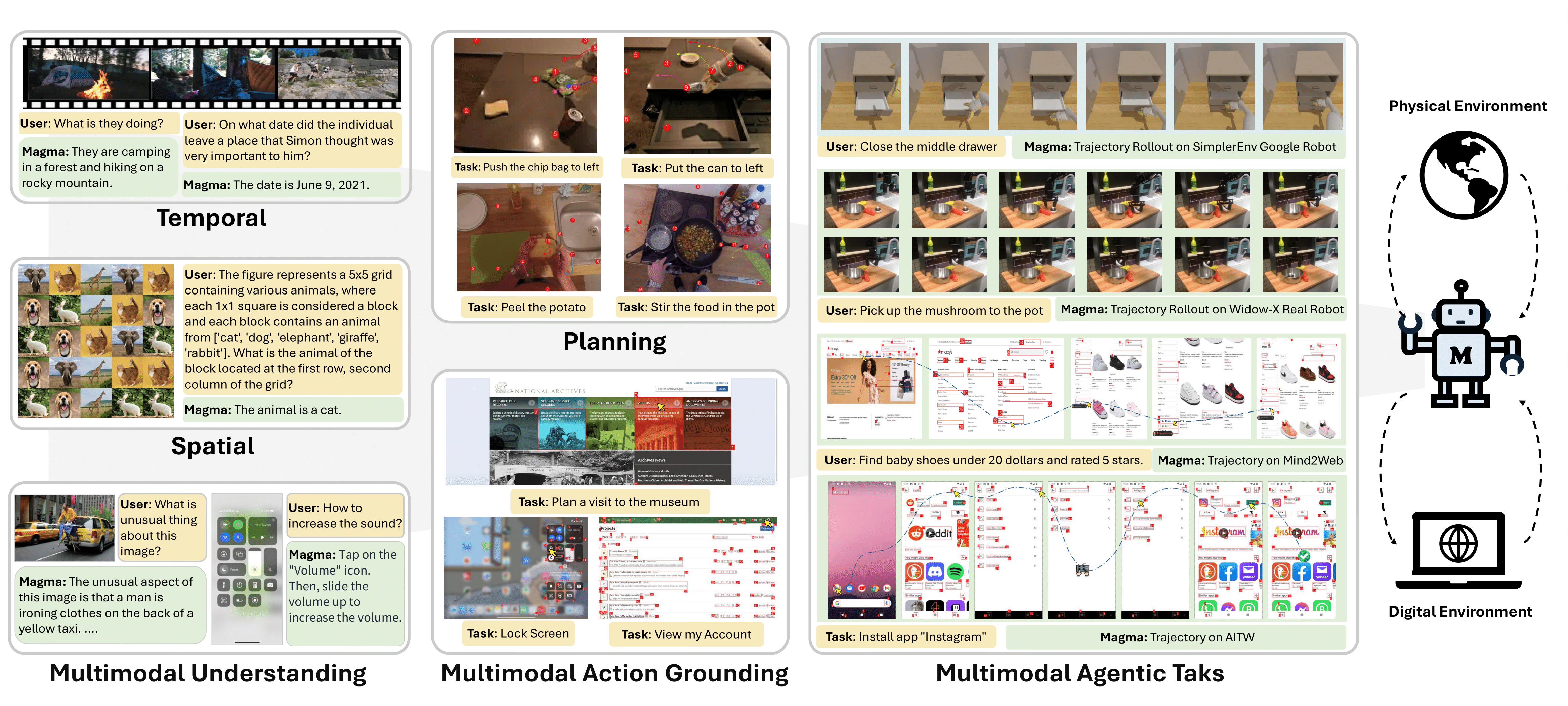
On Wednesday, Microsoft Research introduced Magma, an integrated AI foundation model that combines visual and language processing to control software interfaces and robotic systems. If the results hold up outside of Microsoft's internal testing, it could mark a meaningful step forward for an all-purpose multimodal AI that can operate interactively in both real and digital spaces.
Microsoft claims that Magma is the first AI model that not only processes multimodal data (like text, images, and video) but can also natively act upon it—whether that’s navigating a user interface or manipulating physical objects. The project is a collaboration between researchers at Microsoft, KAIST, the University of Maryland, the University of Wisconsin-Madison, and the University of Washington.
We've seen other large language model-based robotics projects like Google's PALM-E and RT-2 or Microsoft's ChatGPT for Robotics that utilize LLMs for an interface. However, unlike many prior multimodal AI systems that require separate models for perception and control, Magma integrates these abilities into a single foundation model.
Microsoft is positioning Magma as a step toward agentic AI, meaning a system that can autonomously craft plans and perform multistep tasks on a human's behalf rather than just answering questions about what it sees.
"Given a described goal," Microsoft writes in its research paper. "Magma is able to formulate plans and execute actions to achieve it. By effectively transferring knowledge from freely available visual and language data, Magma bridges verbal, spatial, and temporal intelligence to navigate complex tasks and settings."
More on Microsoft’s Magma AI Agent on ARS Technica
Deep Research, OpenAI Inference Chip, Small VLMs, And AI Agent Job Posting
What is all the hype around Deep Research? In episode 43 of IBM’s Mixture of Experts, host Tim Hwang is joined by Kate Soule, Volkmar Uhlig and Shobhit Varshney. This week, we discuss reasoning model features coming out of companies like OpenAI’s Deep Research, Google Gemini, Perplexity, xAI’s Grok-3 and more!
Next, OpenAI is rumored to release an inference chip, but how likely is this to be a success in the AI chip game? Then, we analyze the capabilities of small vision-language models (VLMs).
Finally, a startup, Firecrawl, released a job posting in search of an AI agent. Is this the future for AI tools in the workforce? Tune-in to today’s Mixture of Experts to find out.
Thats all for today, but AI is moving fast - like, comment, and subscribe for more AI news! Thank you for supporting my partners and I — it’s how I keep Neural News free.